 Institute for Chemical Research, Kyoto University
 International Joint Usage Research Center
Welcome
Message from the Director
(Professor, Laboratory of Advanced Solid State Chemistry)
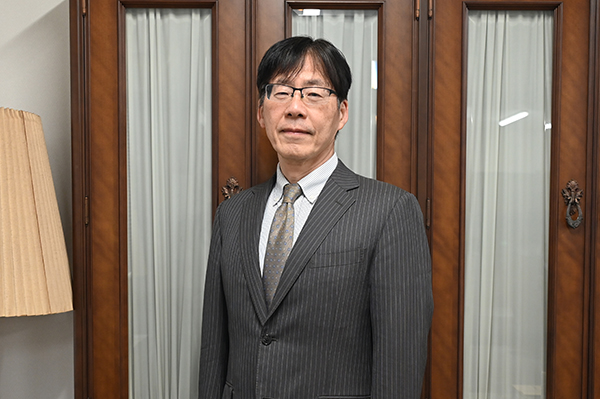
This fall, the Institute for Chemical Research (ICR) will celebrate its 100th anniversary. The ICR began its research activities in 1926 based on founding principle of “excelling in the investigation of the basic principles of chemistry and their applications”. Over the past century, the world has experienced numerous wars and economic ups and downs of varying magnitudes, yet significant development has been achieved. Throughout this history, the expectations placed on “science” and, more specifically, “chemistry” by society have changed dramatically. At times, chemistry has led the way, contributing to the advancement of technology and industry. The ICR has consistently responded flexibly and proactively to the transformations of the times by conducting pioneering and cutting-edge research in various fields to contribute to social development and the cultivation of the human resources involved. On the occasion of our 100th anniversary, we express our deep respect once again for the passion and efforts of our predecessors who built this history and tradition.
ICR currently comprises around 450 members, including approximately 100 faculty members and 250 students. It operates under a research organization consisting of five research divisions (Synthetic Chemistry, Materials Chemistry, Biochemistry, Environmental Chemistry, and Multidisciplinary Chemistry) and three research centers (Advanced Research Center for Beam Science, International Research Center for Elements Science, and Bioinformatics Center). Our role as a Joint Usage/Research Center (JURC) —supported by Ministry of Education, Culture, Sports, Science and Technology (MEXT) as “the Frontier and Interdisciplinary Research Core for Deepening Investigation and Promoting Collaboration in Chemistry-oriented Fields” (Phase II)— is particularly significant. As a hub for international chemical research, we have produced numerous collaborative research outcomes while actively promoting international exchange among young researchers. In recent years, research related to these activities has expanded into several large-scale projects and industry-academia collaborations, demonstrating that our research and management structure have functioned reasonably well. Nevertheless, considering the rapid advancements in science and society centered on AI, as well as the dramatic changes in social systems following the COVID-19 pandemic, I have felt keenly since appointed the director position that it is time to review our organization and operations. In light of these circumstances, Kyoto University was selected as a candidate for the Universities for International Research Excellence at the end of 2025 and has begun reforming its university-wide research organization based on a department system. In other words, we have found ourselves in a situation where we must proceed with organizational reform due to external pressure. However, this can also be seen as an opportunity when viewed from another perspective. While aligning with the direction of the university-wide reform is necessary, I intend to take this as an opportunity to improve the ICR and make it more efficient research organization. The university has set a timeline for the university-wide reform and the launch of the new organizational structure, which has raised concerns about whether we will have sufficient time to thoroughly discuss reform. Nevertheless, I will work with all members to actively discuss the future direction of the ICR. With an eye toward the sustainable development of society and the advancement of science and technology to create a more prosperous future, we will discuss the direction in which the ICR should move and the role it should play from a broad perspective. In that sense, I recognize this year as a crucial one for laying the foundation for the next 100 years of the Institute.
My two-year term as Director ended at the end of fiscal year 2025. However, with my reappointment for the 2026 fiscal year, I intend to approach the management of the Institute with renewed enthusiasm. Professors Toshiharu Teranishi and Teruo Ono will continue to serve as Deputy Director and International Joint Research Station Director, respectively. Additionally, we have appointed Professor Shinjiro Yamaguchi as the new Deputy Director to assist in the Institute’s operations, replacing Professor Tatsuo Kurihara, who served in this role for four years. We will proceed with operations under this new structure, inviting newly appointed young faculty members to participate in the Institute’s internal committees. We would like to ask for your continued understanding and great support.
April 2026

Our Mission
The founding philosophy of the ICR is to “excel in the investigation of the basic principles of chemistry and their applications,” and the core values of its research lie both in independence and integration. Following this philosophy and core values, the ICR is dedicated to solving global chemical challenges to benefit society.
Research:
Our research is based on examining fundamental questions about the wide field of chemistry with a viewpoint that considers how answering these questions will contribute to solving ever-changing global challenges.
Education:
Providing excellent research opportunities in a world-class enviroment, we train our people to have high-level problem solving skills and leadership skills to globally push forward the field of chemistry. Our success comes from the success of our students becoming top scientists in chemistry.
Outreach :
As researchers and educators of chemistry, we endeavor to deepen our exchanges with local communities and Japan as a whole. At the same time, we actively work with international researchers and institutions to solve global problems. By joining the ICR, researchers have the accountability to the public and the opportunity to work closely with leading scientists around the world.